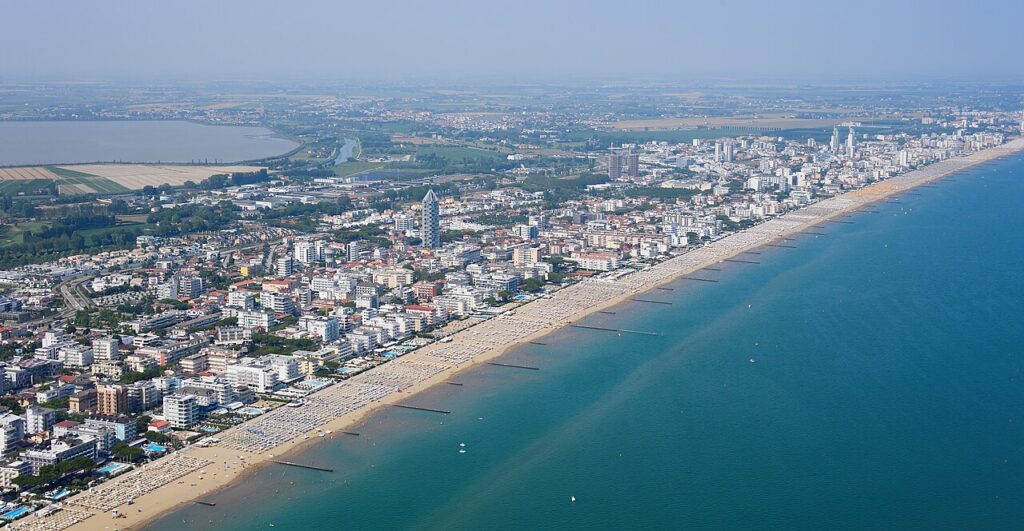
Jesolo is the Veneto beach that, more than any other, shaped the image of the Italian seaside holiday: fifteen kilometres of unbroken sand between the mouths of the Sile and the Piave, with a lattice of lagoons and waterways behind it and the northern Adriatic in front. This site is an independent guide to the destination and the stretch of coast around it, from the Cavallino-Treporti peninsula in the south to Eraclea and Caorle to the north-east. We work as an autonomous editorial newsroom: we do not manage bookings, we do not sell stays, and we do not receive payment from the properties we write about.
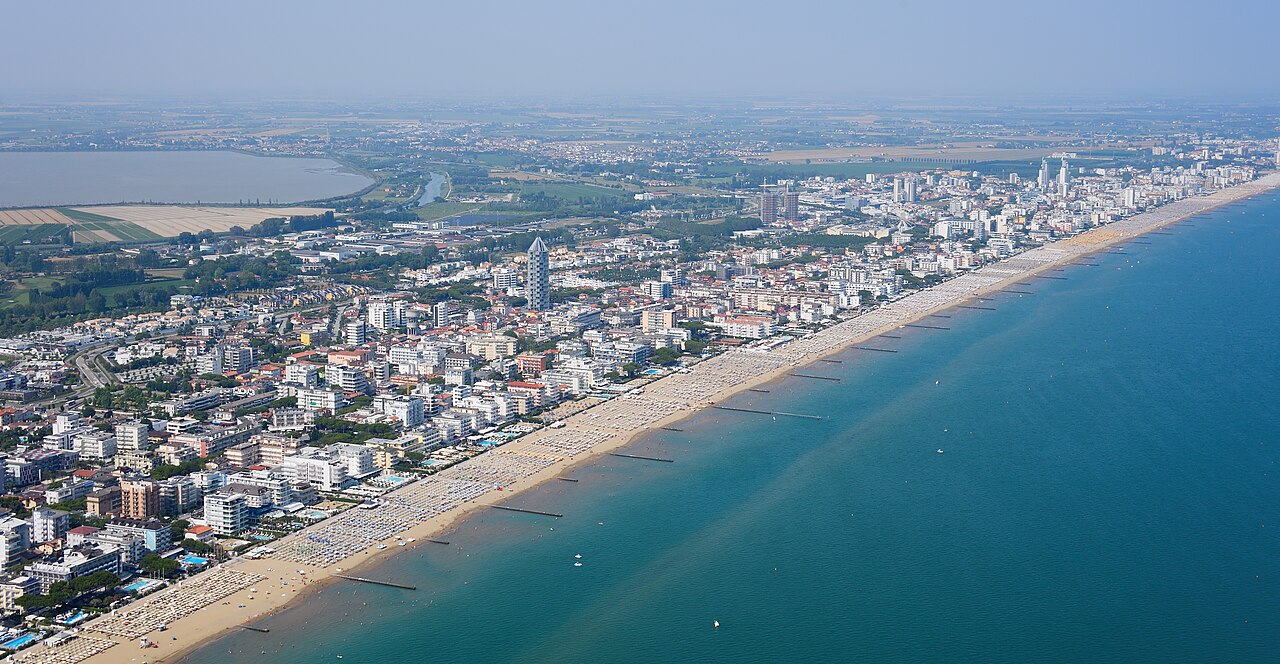
Here we collect detailed pages on each section of the beach, on the surrounding area — Venice, the lagoon, the Cavallino peninsula, the smaller resorts up and down the coast — and a calendar of the seasons, average prices and the events that animate the shore from May to September. Our perspective is that of the traveller looking for plain information before booking: which parts of Via Bafile are pedestrianised and which are not, how far the beach really is from the various sections of the Lido, how to get around without a car, and in which month it makes sense to choose Jesolo rather than Cavallino or Caorle. The domain name recalls the old Hotel Panorama at Via Bafile 343, a small family-run 3-star property that closed around 2021-2022 and which we have given a dedicated memorial page.
Why Jesolo, and why an independent guide
The first reason is the shape of the shoreline. Fifteen kilometres of fine sand, often more than a hundred metres wide, with a seabed that shelves so gently you can walk dozens of paces before reaching deep water. It is a geography made for families with small children and for anyone who does not enjoy plunging straight into the deep, and it explains why Jesolo became, as early as the 1960s, a mass destination for visitors from northern Italy, Austria, Germany and central Europe. The proportions have shifted today, but the structure of the coastline remains the same, and it is what continues to sustain a destination so close to Venice yet so distinct from it.
The second reason is the density of services. Via Bafile, which runs parallel to the beach for around thirteen kilometres, is one of the longest pedestrianised commercial streets in Europe. Shops, restaurants, ice-cream parlours, evening bars, children’s activities, markets, square-side events: the urban strip of Jesolo offers an intensity of choice that is hard to match anywhere else on the northern Adriatic. For visitors who want a slow holiday — bedroom, parasol and supper all within a bubble of a few hundred metres — it is a formula that remains difficult to beat.
The third is the location. From Jesolo, the historic centre of Venice is reachable in about ninety minutes by water taxi from the Mediceo harbour, or by bus and vaporetto via Punta Sabbioni; Venice Marco Polo airport is roughly half an hour by car, Treviso airport about forty minutes. Treviso, Padua and the Venetian villas are within an hour’s drive. It is a rare case of a beach that stops being a dead-end and becomes a base for exploring the wider region.
And why an independent guide. The Italian web lacks editorial space that talks about this destination in a non-commercial register. The big booking portals present hotels in catalogue mode, the websites of individual hotels describe only themselves, and the generalist press contents itself with a few seasonal articles about “the favourite beach of the Italians”. What is missing is a newsroom willing to describe each section of the coast one by one, tell the differences between one season and the next, and admit honestly when a period is best avoided and when it is genuinely worth coming. That is the space we are trying to occupy.
The main zones of the coast
Jesolo Lido
The Lido is the seaside part of the town: it runs from the mouth of the Sile in the west to the so-called Cortellazzo in the east. The central strip, from the area around Piazza Brescia to Piazza Mazzini, is the heart of the evening and commercial life, with the pedestrian section of Via Bafile; eastwards the fabric becomes more residential, with villas and family-scaled apartment blocks; westwards, towards Cavallino, the seafront is more orderly, with traditional beach clubs. See the detailed page on the beach.
Jesolo Paese
The original inland town, a few kilometres back from the Lido, still has its town hall, cathedral, central square and the historic fabric of Equilio, the old lagoon bishopric. It is not a tourist destination in the conventional sense, but it is worth visiting if you want to understand where the place name comes from, or for a quiet trattoria meal away from the beach circuit. It sits about five kilometres from the sea.
Cavallino-Treporti
Immediately south of Jesolo, separated by the Sile estuary and the harbour, the peninsula of Cavallino-Treporti is an autonomous municipality with a different character: wider, quieter beaches, a dense network of campsites and holiday villages that draws a significant share of the European seaside market on our upper Adriatic, and a direct outlook over the northern Venetian lagoon. It is the natural choice for anyone seeking more calm and more contact with nature, and it is only a few minutes from Jesolo.
Eraclea and Caorle
Eastwards, beyond the mouth of the Piave, the shoreline of Eraclea Mare begins and then that of Caorle. Eraclea is the classic affordable family beach, with a pinewood behind it and a generous expanse of sand. Caorle adds a small Venetian-style old town that is highly photogenic, with a cylindrical bell tower, colour-washed lanes and a working fishing fleet. More in the guide to the surrounding area.
When to come
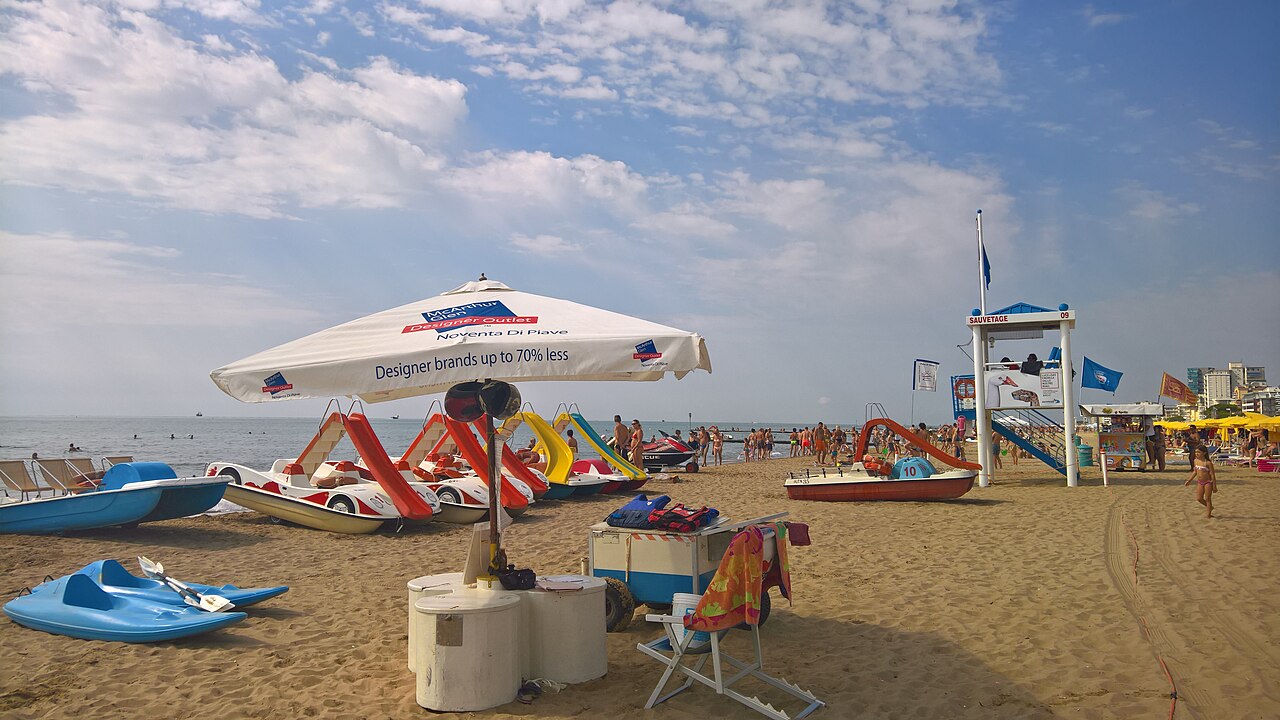
High season falls in July and August: average temperatures of 28-30 degrees, warm sea, packed beaches, prices at their peak. The week around Ferragosto (15 August) is the busiest of the year and requires booking well in advance. For a compromise between summer weather and a less congested atmosphere, the best windows are the second half of June and the first half of September: the sea stays warm, the beach clubs are still open, Via Bafile is alive but without the August weekend crush.
May is a month apart: temperatures are often mild, with the occasional day already good for swimming, but a high proportion of changeable weather. A sensible choice for those wanting to combine beach days with excursions to Venice or the Venetian villas, at prices that remain affordable. The second half of September is ideal for the sand sculptures festival, the event that has animated the seafront for more than two decades; October brings the first Atlantic storms and the closure of nearly every property.
The story behind our name
The domain hotelpanorama-jesolo.it belonged to the Hotel Panorama at Via Bafile 343, a small family-run 3-star hotel managed by Stella and Alessandra. Web archives show the original site online from at least 2002 as a simple brochure page, until 2016, when it was rebuilt on WordPress; the last versions of the site date to 2021, after which the domain was deregistered and parked. The hotel offered beach-front rooms, a private equipped beach, a sunny breakfast room and a roof-bar terrace, in a central position twenty metres from the sea and five hundred metres from Piazza Mazzini.
We decided to acquire the domain after its release and to use it for a new editorial project, with a memorial page that documents — as honestly as the Wayback Machine allows — what is known about the original hotel. Read the history of the Hotel Panorama.
Start here
- Jesolo holidays — 2026 guide: how to plan the trip, average prices, transport, advice for families and couples.
- The beach of Jesolo Lido: the sections of the coast, the squares, the beach clubs, the sand, the seabed.
- Around Jesolo: Venice, the northern lagoon, Cavallino-Treporti, Caorle, Treviso.
- Things to do in Jesolo: family activities, water sports, events, nightlife.
- Hotel Panorama — the history: the memory of the property at Via Bafile 343.
Enjoy the reading, and enjoy your stay on the upper Adriatic.