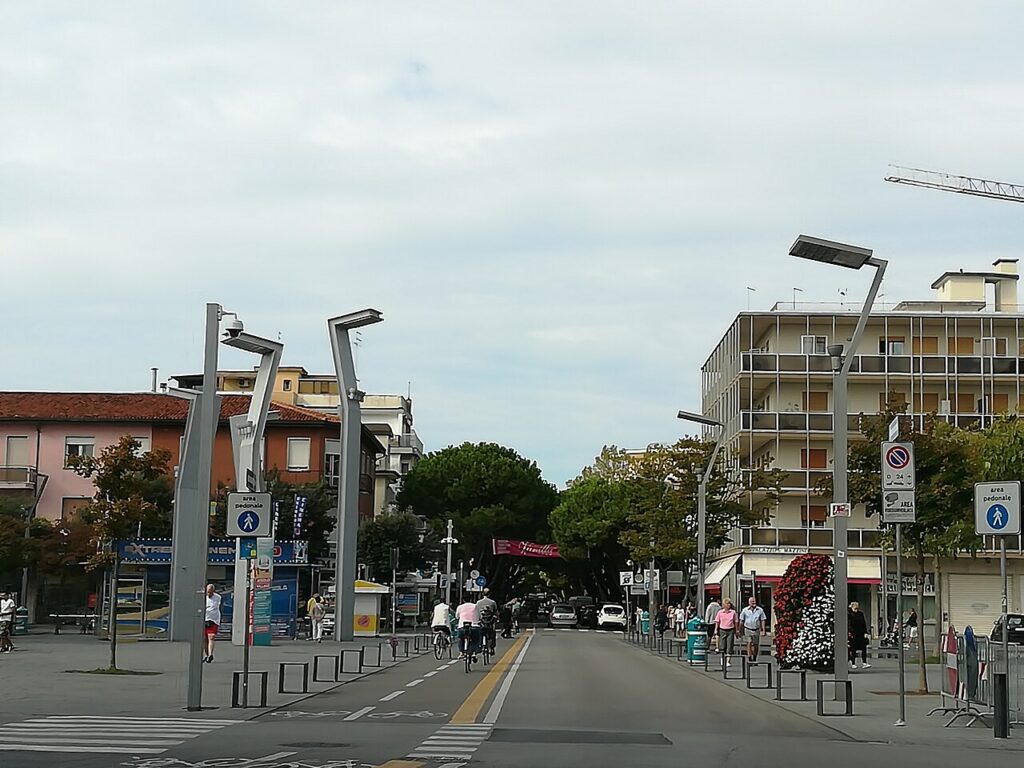
Planning a holiday in Jesolo means making a few specific choices: which stretch of the Lido to stay in, which month to come, how to get there, how much time to give to the sea and how much to the surrounding region. This guide tries to answer those questions as plainly as possible, without brochure language and without selling anything. The information is updated to spring 2026 and draws on publications by Federalberghi Veneto, data from APT Venezia and our own checks on the ground.
The geography of the coast: how Jesolo is laid out
Jesolo Lido stretches for about fifteen kilometres along the Adriatic coast, between the mouth of the Sile to the west and that of the Piave Vecchia (the Cortellazzo) to the east. The urban structure is simple: one main road parallel to the sea — the famous Via Bafile — runs behind the front row of hotels; cross-streets link Via Bafile to the beach by short access roads known as “accessi al mare”, numbered from one to twenty-eight from east to west.
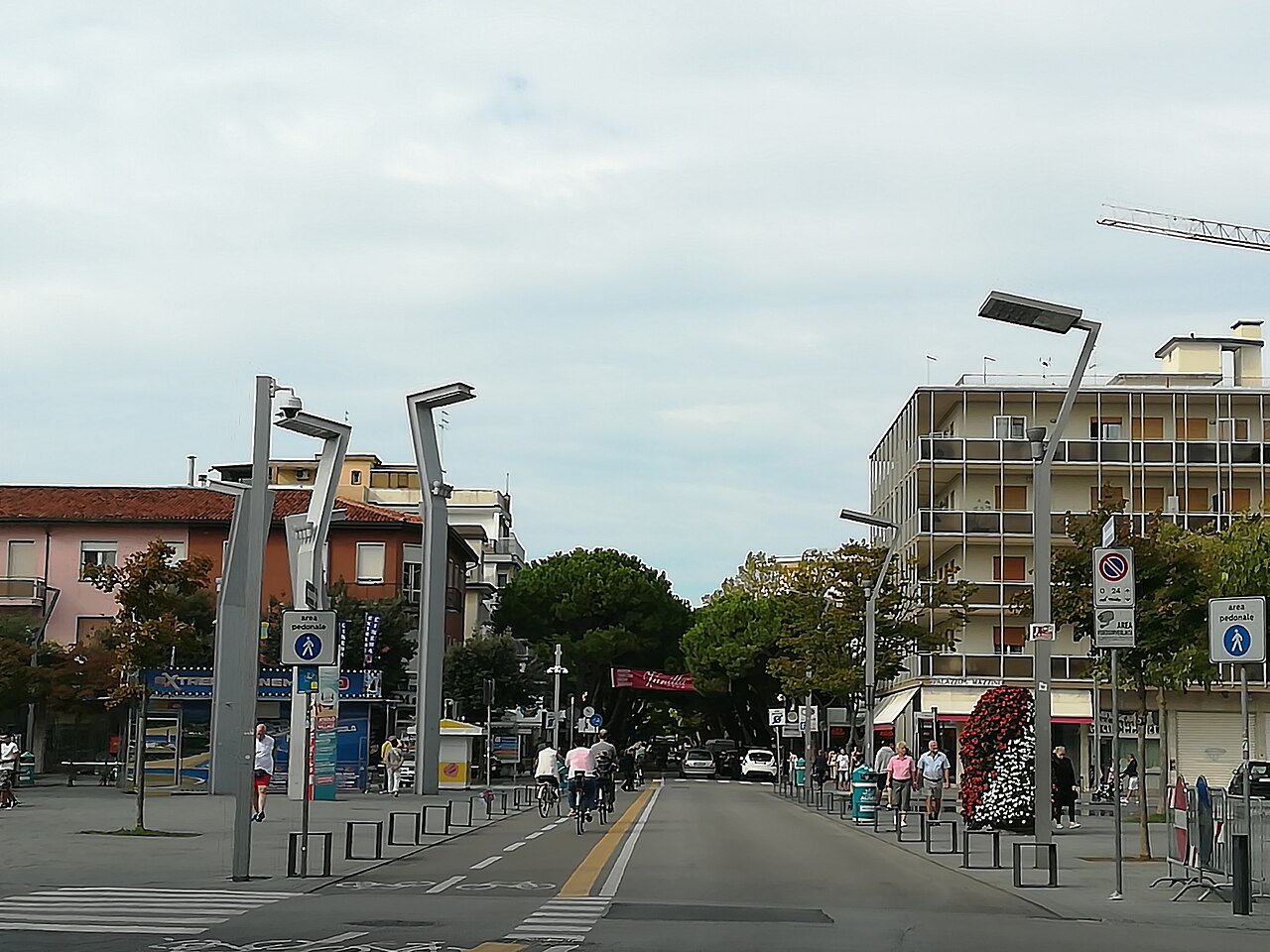
Knowing the number of the beach access is the quickest way to orient yourself in Jesolo. The squares act as reference nodes. Piazza Brescia, at the first access, is the eastern edge of the commercial heart; Piazza Mazzini, near the twenty-first access, is the central pedestrian square, animated by markets, concerts and the great winter Christmas tree; Piazza Marconi, at the fourteenth, is a secondary square with a fountain and children’s rides. Westwards the seafront thins out until it reaches Jesolo Pineta, the more residential pinewood zone.
The character of the urban fabric shifts as you move along the coast. The central strip, from the third to the twenty-first access, is the liveliest: a concentration of hotels of every category, restaurants, ice-cream parlours, play areas and evening venues. The eastern strip, from the first to the third, is more modern, with large apartment complexes and a few chain hotels. The western strip, from the twenty-first onwards and out through the pinewood, is the quietest, with villas, family residences and a historically loyal clientele.
When to come: the season and its months
Jesolo is strictly a seasonal destination: nearly every property opens between late April and early May and closes between the first and second week of October. The differences between the months are substantial in terms of climate, prices and crowding.
May
Average daytime temperatures of 19 to 24 degrees, the sea still cold (16-19 degrees), often breezy days. It is the ideal month for combining walks on the seafront, excursions to Venice and the Venetian villas, and a few days of sun on the sand, with prices still low. Not recommended for those expecting a classic beach holiday: the water is too cold for easy swimming and a few rainy days should be expected.
June
The first half of the month is still transitional; the second opens the swimming season proper. Average temperatures around 26 degrees, sea between 22 and 24 degrees. Average prices are 25-35% lower than the August peak, beaches are never crowded, and the school-trip season is over. Statistically, it is the best month of the year for those who can put up with the occasional afternoon storm.
July and August
The peak of the Adriatic summer. Average daytime temperatures of 28-31 degrees, sea at 24-26 degrees, with the first north-easterly waves usually arriving in mid-July and again at the end of August. Beaches are busy, the pedestrianised Via Bafile is packed in the evenings, every beach club is open, and there are public events almost every weekend. The week of Ferragosto (10-20 August) is the most crowded and the most expensive, with hotel rates often 60-80% above those of June.
September
The favourite month of those who know Jesolo well. The first week is still fully summery, with the sea warmed by the previous months (24-25 degrees) and temperatures around 26-28. From mid-month the days shorten, the first hint of autumn arrives with the odd storm, but prices fall and the beaches empty out. The second half hosts the sand sculptures festival, the international event that has run along the seafront for more than two decades and pulls in a spike in daily visitors.
Getting there
By car
The main motorway is the A4 Venezia-Trieste, exiting at Noventa di Piave or Quarto d’Altino. From the Noventa exit, regional roads 43 and 14 reach Jesolo in about 20 minutes; from Quarto d’Altino, provincial road 42 is a slightly busier summer option. Typical driving times: about three hours from Milan, two from Bologna, two and a half from Verona, an hour and a half from Trieste. From mid-June to the end of August, Saturdays are the heavy-traffic days, with queues at the Venezia Est toll plaza and on the approach roads to the Lido.
By plane
The two relevant airports are Venice Marco Polo (at Tessera, about 35 kilometres away) and Treviso Antonio Canova (about 45 kilometres). Marco Polo is better connected for private transfers and taxis, with journey times of 40-50 minutes via the ring road; Treviso handles more low-cost flights and runs a seasonal direct ATVO bus in summer. There is also an Alilaguna water-taxi service that links Marco Polo to Punta Sabbioni, from where Jesolo is around 15 minutes by car or bus.
By train and bus
There is no railway station in Jesolo itself. The nearest stations are Venezia Mestre, Venezia Santa Lucia and San Donà di Piave. From Mestre and Santa Lucia the ATVO E13 bus runs directly to the Lido in around 50 to 70 minutes depending on traffic, with very frequent services in summer. From San Donà di Piave (on the Venice-Trieste line, 30 minutes from Mestre station) there are local buses to Jesolo in about 30 minutes — the preferred route for visitors coming from the north-east.
Where to stay: choosing between the zones
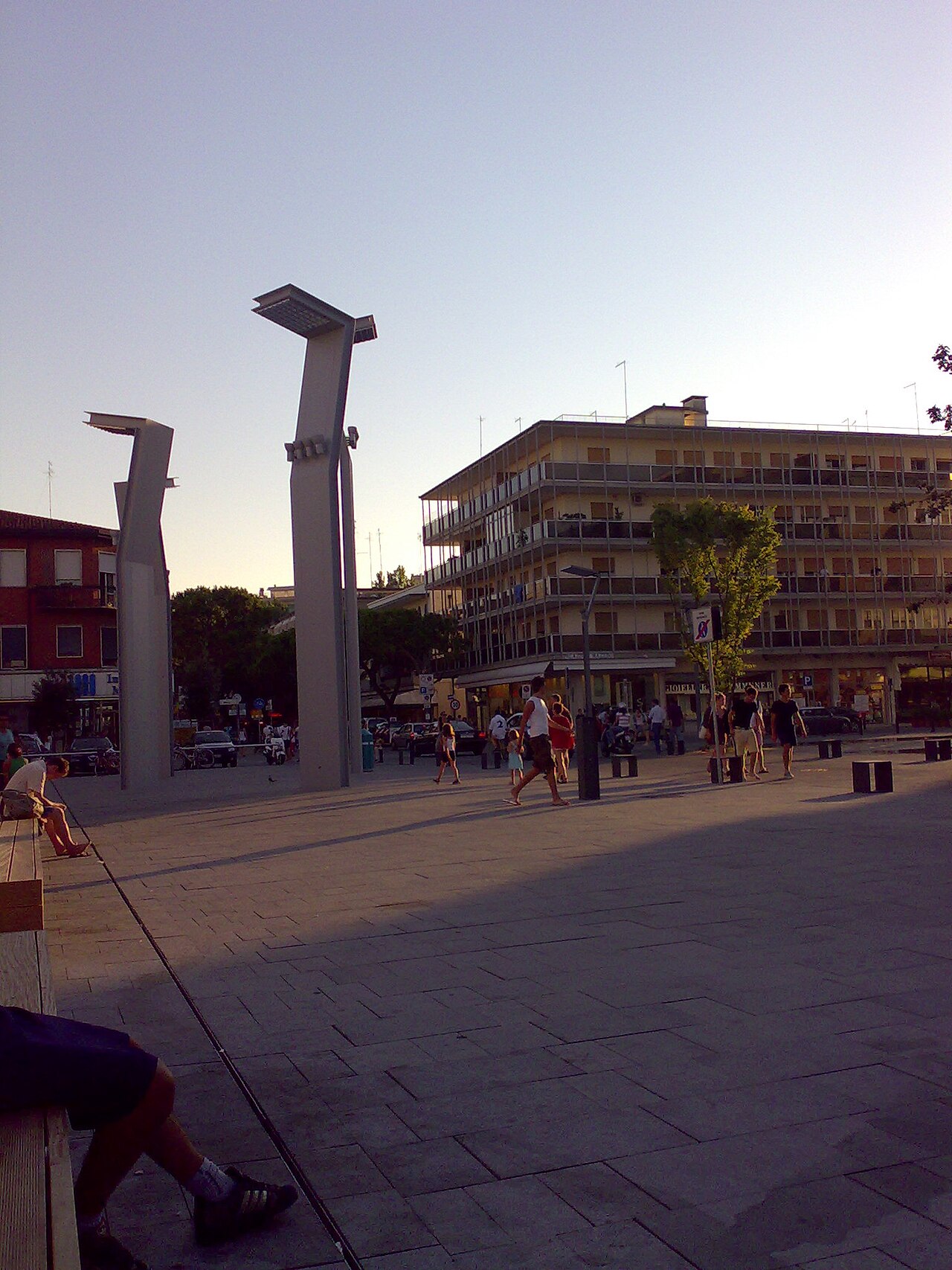
Jesolo Lido offers several hundred hotels, residences and holiday apartments, spread across three macro-zones. There is no single “best” zone: each answers a particular need and a particular holiday style.
Central zone (accesses 3 to 21, between Piazza Brescia and Piazza Mazzini). The commercial and evening heart. The widest range of hotels across all categories, from family-run 3-stars to superior 4-stars. Suited to those who want everything within walking distance: beach, restaurants, bars, evening events. Not ideal for guests needing complete quiet at night, particularly at weekends in July and August.
East zone (Piazza Brescia and beyond, towards the harbour). The more modern part, with large hotel complexes built from the 2000s onwards and several contemporary residences. The beach is fine and the distances are slightly greater. Suited to those looking for new properties with pool and wellness facilities, and to larger family groups needing self-catering options.
West zone (Pineta and surroundings). Quieter, with villas, residences and a few small historic hotels. The beach is identical to the central zone but with less foot traffic; evenings are far quieter, with only a handful of restaurants animating the night. Suited to families with small children, older travellers, and anyone seeking a restful holiday without giving up the sea.
Whichever zone you choose, check before booking the exact distance to the beach access and the position of your parasol within the beach club: many Jesolo properties have an affiliated or owned beach, but the row in which the parasol sits is not always at the front. The plan of the beach club is usually published on the website of each property.
Prices: orders of magnitude
What follows are orders of magnitude, not precise tariffs: rates vary considerably between properties and change every year. The figures are per person per night in a double room with breakfast, and reflect the average of 3-star hotels along the Lido.
- May and first half of June: 45-65 euros per person per night.
- Second half of June and first half of July: 65-85 euros.
- Second half of July and first part of August: 80-110 euros.
- Ferragosto week: 110-160 euros, with a 7-night minimum stay usually required.
- First half of September: 60-80 euros.
- Second half of September: 50-65 euros.
Four-star hotels sit on average 30-50% above these bands; holiday apartments and residences typically save 20-30% in exchange for a weekly minimum stay and the absence of hotel services. Half-board, very common in Jesolo, adds on average 15-25 euros per day per person and is almost always cheaper than paying à la carte in the seafront restaurants.
Families with children: what to look for
Jesolo has historically been built around family tourism and is one of the most organised Italian destinations for those travelling with children. A few things to weigh when choosing a property: whether the pool has a shallow area for younger children, whether there is an entertainment service (common in Jesolo’s 3- and 4-stars), the “child free” formula (offered by many properties for children up to 8-12 years sharing their parents’ room), and the position relative to the first or second municipal miniclub on the square.
On the beach itself, the gently shelving seabed lets children move around freely along a wide strip of shoreline. Almost every beach club has play areas, indoor children’s rooms and lifeguards trained to assist the youngest. Average prices for the “family set” (parasol, two sun-loungers, one deck-chair) range from 25 to 45 euros per day depending on the club and the season. For child-focused activities away from the beach, see the dedicated page.
Getting around without a car
Once you are in Jesolo, it is perfectly possible to do without a car. The ATVO local bus network covers the entire Lido from east to west, with two high-frequency main lines in summer. Central Via Bafile is pedestrianised between Piazza Mazzini and Piazza Brescia, and in many other stretches during the evening (typically 7pm to 2am). A daily local bus ticket costs around 4 euros and covers the whole seafront. For Venice, the direct option is the ATVO E13 bus or, more scenically, the water taxi from the harbour in Jesolo to Punta Sabbioni and from there the ACTV vaporetto to San Marco.
For short trips, the bicycle is the popular choice: the central zone has continuous cycle paths along Via Levantina and Via Aquileia, and hotels often lend bikes free or for a token fee. Electric scooter sharing is widespread in the central zone, though the western section and the pinewood are less well covered.
Common mistakes to avoid
- Booking too late for August. The best properties on the Lido are sold out by May. Anyone booking in July for August will usually find only second-row or peripheral options.
- Relying only on the big portals. A good share of Jesolo’s family-run hotels offer lower prices by email or telephone than those shown on the booking portals, under agreements that prevent them from publishing the lower rates online. A direct email or phone call is often worth 5-10% off.
- Underestimating the west zone. Many guests instinctively pick the central area to “be in the thick of it” and then complain about evening noise. If the goal is rest, the west zone and the pinewood offer the same beach with a far more discreet evening rhythm.
- Treating Jesolo as a short-break destination. The structure of the coast rewards week-long stays. Hotels are geared to Saturday-to-Saturday turnovers and spot rates for 2-3 nights are often disproportionate.
Combining Jesolo with the surrounding region
A holiday in Jesolo does not have to be only a beach holiday. The position of the coast makes it easy to fit at least three or four days off the sand into a week’s stay. The centre of Venice is a half-day trip even with a mid-morning start; the northern lagoon (Burano, Torcello, Mazzorbo) is reachable from Punta Sabbioni by vaporetto in just over an hour; Treviso is an hour and a half away by bus; and the Venetian villas of the Brenta riviera are about an hour’s drive. More in the guide to the surrounding area.