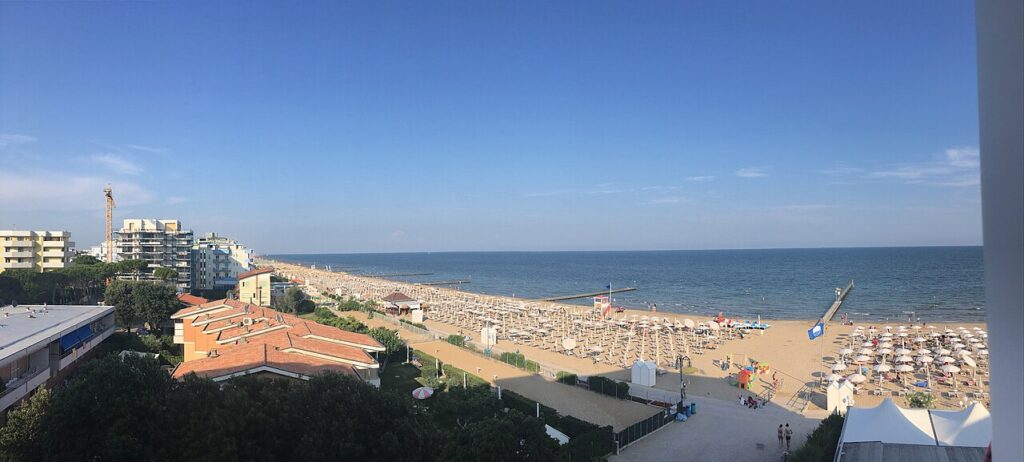
The beach at Jesolo is what turned a small lagoon village into one of Italy’s best-known seaside resorts. Fifteen kilometres of fine sand, with widths ranging from seventy to one hundred and fifty metres depending on the section, and a seabed that shelves so gently you can walk hundreds of metres before the water rises above chest height. This page tries to describe the coastline as it really is, section by section.
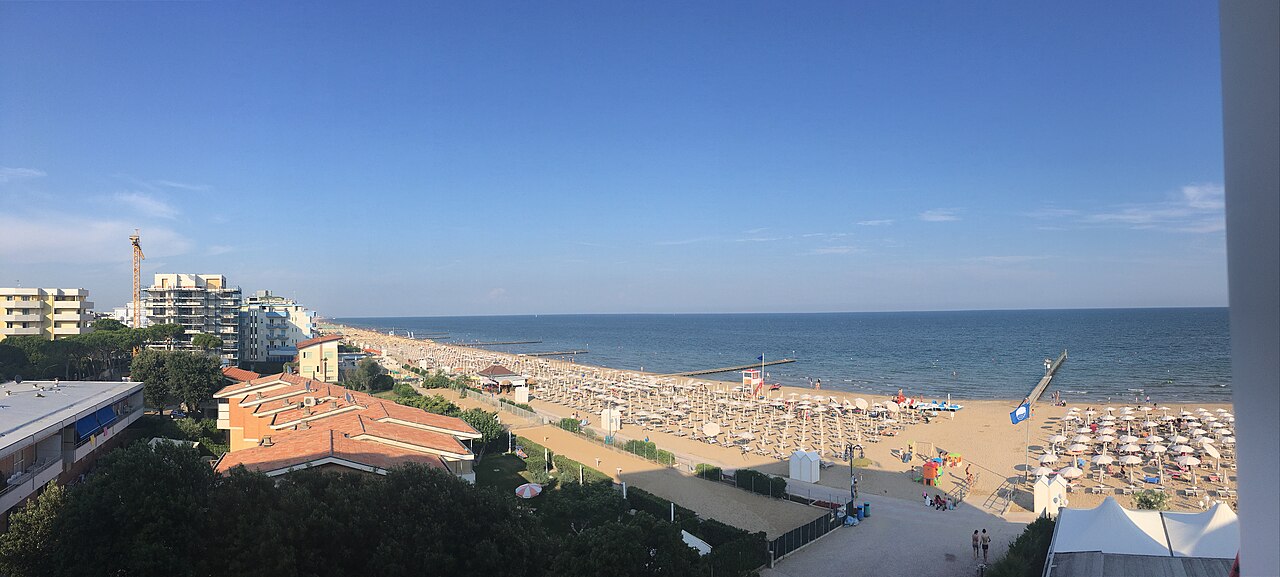
The sand, the seabed, the colour of the water
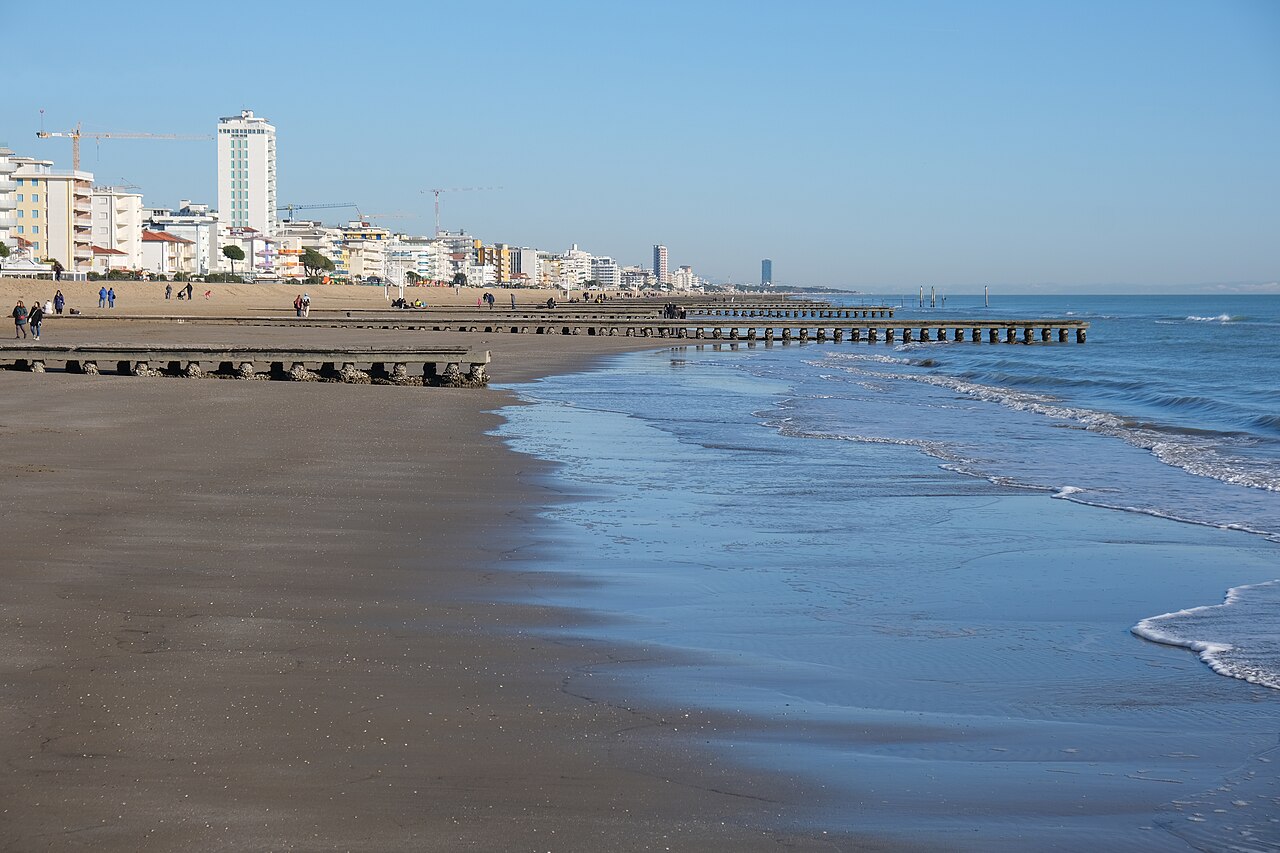
The sand at Jesolo is alluvial in origin, deposited over millennia by the Piave, the Sile and the Brenta. It is fine grained, light in colour with a golden cast, and warm enough to walk on even on the heaviest July days thanks to the prevailing exposure. The natural dunes, much reduced by urbanisation, survive in a few eastern stretches and in the Pineta zone. In recent years the Consorzio Bagnanti and the municipality have launched sand-replenishment programmes to counter the coastal erosion that particularly affects the stretch between the fifteenth and twenty-eighth accesses.
The seabed is the truly distinctive feature. The gradient is about 1% over the first hundred metres, against 3-5% on other Adriatic beaches. In practical terms: on a calm day, a hundred metres from the waterline the water is still only at hip height. This is what historically makes Jesolo the first choice of families with small children. The water, the green-blue typical of the upper Adriatic, is less crystalline than that of the Ionian or Sardinia — not for reasons of pollution but because of the natural presence of river sediment — and in summer it reaches a comfortable 24 to 26 degrees.
On water quality, Jesolo has held the Blue Flag since 2012, the international award by the Foundation for Environmental Education (FEE) certifying bathing and coastal-management standards. Monitoring by ARPAV (the Veneto Regional Agency for Environmental Prevention and Protection) classifies the waters of the seafront as “excellent” at every sampling point.
The sections of the Lido: orienting by beach access
The Jesolo coastline is divided into 28 beach accesses, numbered consecutively from east to west. Every beach club identifies itself by the number of its access and is usually affiliated with one or more hotels in the first and second rows behind. Learning the numbering is the quickest way to understand where you are and what kind of clientele frequents a given stretch.
East section: accesses 1-5 (Piazza Brescia and around)
The eastern edge of the Lido proper. Piazza Brescia is the large modern square that opens onto Via Bafile, with a recognisable architecture of concrete and fountains. The beach here is wide and tidy, frequented by large hotel-residences and an international clientele. The far east, towards the mouth of the Piave, is a less developed stretch with residual dunes in a few spots. Evening life: high, especially along the Piazza Brescia axis.
Central section: accesses 6-15 (Piazza Trento, Piazza Marconi)
The traditional heart of beach-going Jesolo, where most of the historic 3-stars and classic 4-stars cluster. The beach is organised in regular rows of parasols by mid-sized clubs, each with bar, small restaurant, shower and lifeguard. Piazza Trento and Piazza Marconi are afternoon and evening meeting points, with fountains, children’s rides and stalls. Evening life: medium-high, with a concentration of ice-cream parlours, pizzerias and aperitivo bars along Via Bafile.
Central-west section: accesses 16-21 (Piazza Mazzini)
Piazza Mazzini is the pedestrian fulcrum of the Lido: Via Bafile, Via Padova, Viale Oriente and Via Aquileia all converge here. The square is large and paved, hosts free concerts and themed markets in summer, and is home in winter to the great Christmas tree that remains one of the resort’s most recognisable images. The beach in front of the two main blocks is among the busiest of the Lido, served by beach clubs of traditional family management. Evening life: at its maximum, with the highest concentration of late-night venues and pedestrian flow along the seafront.
West section: accesses 22-28 (Casabianca, Pineta)
The western part of the seafront is markedly calmer. Beach clubs draw a historically faithful clientele, often families who have returned to the same parasol for decades. Residual dunes and the pinewood behind create a more discreet atmosphere, with villas in place of large hotels. Jesolo Pineta (a common but not municipal designation) is a sub-area appreciated for the quiet and the natural shade of the trees. Evening life: low, with quality dining at a few addresses but almost no nightlife.
The beach clubs: how they work
In Jesolo the state-owned beach concessions are organised into “bagni” or beach clubs, usually identified by the number of the beach access. Each club offers a standard service of parasol plus sun-loungers and deck-chair, with daily, weekly and monthly rates. Indicative average tariffs for the 2026 season, based on the price lists published by the Consorzio Bagnanti:
- Parasol + two sun-loungers, front row: 30-40 euros per day in high season, 18-25 in low season.
- Parasol + two sun-loungers, subsequent rows: 20-30 euros per day in high season, 12-18 in low season.
- Weekly rate: typically the cost of six days for seven of use.
- Monthly rate: between 350 and 700 euros depending on season and position.
Almost every beach club includes fresh-water showers, toilets, children’s play area, equipment store and lifeguard service. Many also have an in-house bar and small restaurant, water-aerobics or pilates classes, tennis and volleyball lessons on the sand, and rentals of SUP boards, canoes and pedalos. The children’s play areas, often very well kept, are one of the defining marks of the Jesolo coast.
Hotel guests generally have access to the affiliated beach club at no extra charge, with the cost folded into the room rate. When booking, check the number of the affiliated access and the row reserved to the property: the difference between front and fifth row can be significant in August, when the cool damp of the shoreline is preferable to the firmer dry sand towards the dunes.
Free beach: where and how
Although Jesolo is one of the most concessioned beach destinations in Italy, a few sections of free beach do exist. The main ones are: the stretch by the breakwaters to the east, between the harbour and access 1; a short patch between the tenth and eleventh accesses; and a few gaps between beach clubs in the western section, particularly in the pinewood zone. Access in these areas is free, but there are no services (no showers, toilets or lifeguards) and no parasol rental. Bring everything you need, including a parasol, a cool-box and water.
The municipality of Jesolo publishes the map of free-access stretches each year on its official website, with precise boundary information. From mid-June to mid-September a mobile lifeguard service is generally active in these areas under the Consorzio Bagnanti, but coverage is not continuous as it is in the beach clubs.
When the sea is rough
The upper Adriatic generally has small waves, rarely above a metre and a half, but it can turn rough when strong bora winds blow from the north-east or scirocco from the south-east. In those cases the flag system is activated along the whole coast, with a red flag prohibiting swimming. Flags are visible on every lifeguard tower. A day of strong bora is usually a day of full sun, but with a difficult sea and short, powerful waves close to the shore: respect the warning even if the sky is clear.
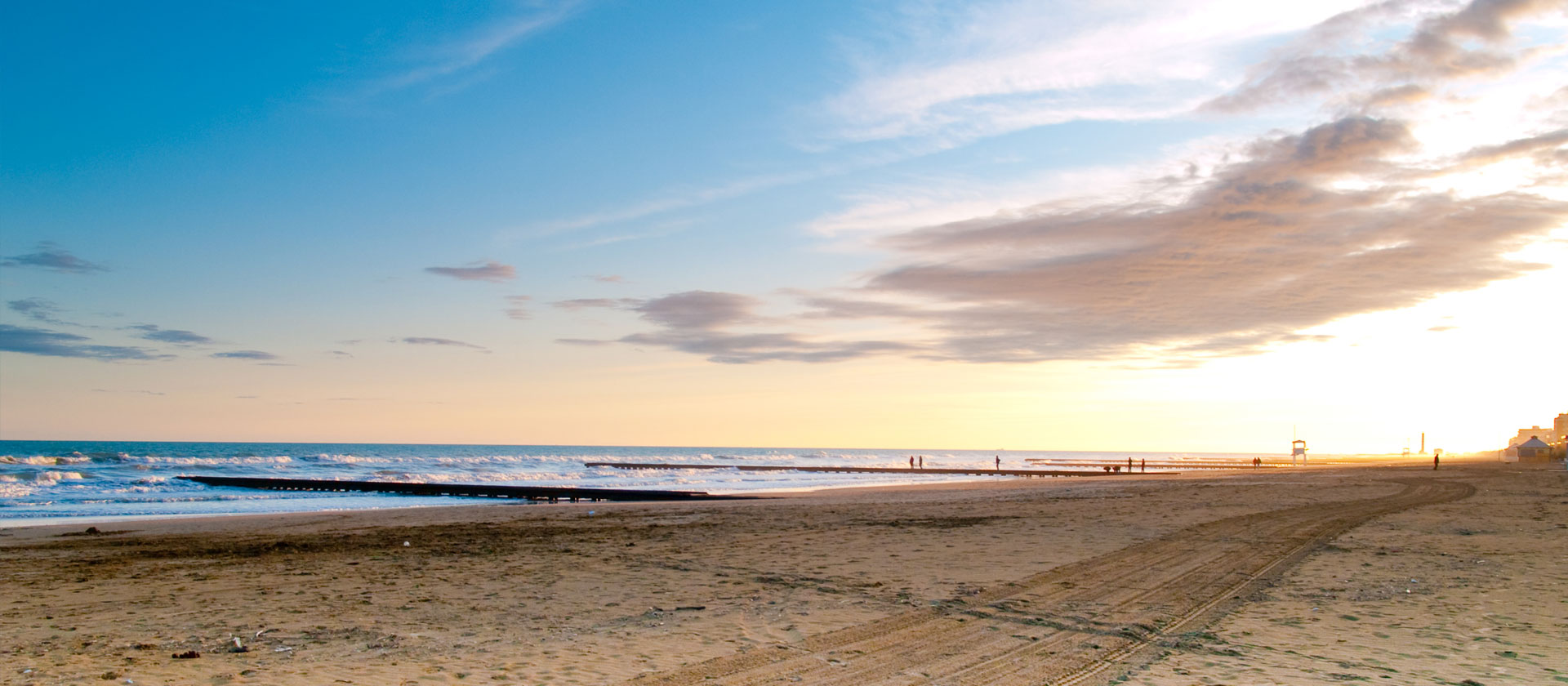
Genuine sea storms are rare in summer and more common between October and March, the months when the beach is closed and sand replenishment is normally scheduled. For those who enjoy the sea out of season, winter mornings offer a spectral, beautiful coastline, frequented by runners, anglers casting from the shore, and walkers padding barefoot on the damp sand.
What to take to the beach
The average Jesolo beach club supplies parasol, sun-loungers, chair and shower. It is still worth bringing a few things: UV sunglasses, a wide-brimmed hat (sun exposure on the Adriatic is less harsh than on the Tyrrhenian but constant), a water-resistant sunscreen, a bottle of water, a book or something to occupy the hotter afternoon hours. For children: buckets for the sand (which is ideal for castles), reef shoes (not needed on this stretch of coast), and a small sun-tent if you are out for many hours with a baby.
Dogs are admitted on the beach at Jesolo only in certain dedicated clubs (“Bau Beach” and similar), as the municipal regulations do not allow them along the whole coast. Pet-friendly areas tend to cluster between accesses 7 and 12 and are signposted accordingly. It is worth checking in advance, as maps may shift from year to year. For activities away from the sand, see the dedicated page.